Anant Chaturdashi as it falls in 2061.
Next date: 14 September 2027Anant Chaturdashi 2061
Wednesday, 28 September 2061, in Ahmedabad
FestivalGujarati · Hindu
Panchang on the day
28
Wednesday
Waxing Fourteenth
until 16:47
Aquarius
- ગGa
- સSa
- શSha
- Sunrise
- 06:29
- Sunset
- 18:30
- Moonrise
- 17:57
- Nakshatra
- Purva Bhadrapada
- until 00:02 next day
- Yoga
- Ganda
- until 21:42
- Karana
- Vanija
- until 16:47
- Rahu Kalam 12:30 to 14:00
- Yamaganda 07:59 to 09:29
Why this date
Bhadrapad Waxing Fourteenth, taken at sunrise
Runs from 27 Sep 18:00 IST to 28 Sep 16:47 IST.
In short
Anant Chaturdashi is observed on the fourteenth day of the bright half of Bhadrapada by worshipping Vishnu as Anant. The sacred thread with fourteen knots is a familiar part of this worship. This is the vow story of Sushila and Kaundinya from the Gurucharitra. Ganesh immersion on the same lunar date belongs to a separate tradition.
The story
The Pandavas had lost their kingdom in a deceitful game of dice and were living in the forest. Yudhishthira, his brothers and Draupadi faced many hardships. The Kauravas tried to trouble them even there, and Krishna protected them. Once Krishna came to visit. The Pandavas welcomed him affectionately, worshipped him with flowers found in the forest and told him of their suffering. Yudhishthira asked what they could do to overcome these troubles and find peace of mind.
Krishna advised them to observe the Anant vow. He explained that Anant was not some distant, unknown deity: he himself was Anant, present everywhere in the world. His power was in day and night, months, years and ages, and in the sun, moon, directions, seas, mountains, rivers, trees and stars. He was also present as Brahma, Vishnu and Mahesh. From the smallest particle and blade of grass to the fourteen worlds and Patal, he was everywhere. Yudhishthira asked when and how this vow was observed, and who had first kept it. Krishna named the fourteenth day of the bright half of Bhadrapada and told an old story.
In Krita Yuga, there lived a Brahmin named Sumantu of the Vasishtha lineage. His wife Diksha was Bhrigu's daughter. They had a daughter named Sushila. After some time, Diksha died. Sushila grew up with devotion and good conduct. She decorated the house, hung leaf garlands and made colourful rangoli designs of the swastika, conch and lotus. She also took a keen interest in worship.
After his wife's death, Sumantu married again so that the household's religious responsibilities could continue. His new wife was named Karkasha. She was quarrelsome and frequently argued with her husband and Sushila. There was little peace in the house, and Sumantu was unhappy about the situation.
When Sushila reached marriageable age, sage Kaundinya visited Sumantu's home. Sumantu married his daughter to him. The couple remained there through the two months of Ashadha and Shravana. As the quarrels with Karkasha continued, Kaundinya asked permission to move to another hermitage. Sumantu was saddened at the thought of his daughter going far away. Kaundinya assured him that they would make a hermitage nearby and visit often. At her father's request, they stayed a few more days before preparing to leave.
At their departure, Sumantu asked Karkasha to prepare a meal of rice and wheat for his daughter and son-in-law. Instead, she went into an inner room and shut the door. She even placed stones against it so that it would not open. Sumantu pleaded with her, but she would not come out. Sushila told her father that they would leave as they were. In the kitchen, Sumantu found a little wheat bran. He gave it to his daughter and saw them off with a heavy heart.
Sushila and Kaundinya travelled on in a chariot. At noon they reached a riverbank, where Kaundinya got down for his daily worship. Sushila stayed near the chariot. She saw many women dressed in red worshipping sacred pots by the river. She went over to them and asked which vow they were observing.
The women seated Sushila beside them and explained the Anant vow. They said that it was observed on the fourteenth day of the bright half of Bhadrapada. A red thread with fourteen knots was prepared. After bathing, people wore clean clothes and decorated the place of worship. Two new pots, named for Ganga and Yamuna, were filled with water and worshipped with leaves and jewels. A clean cloth was placed on the pots, and an eight-petalled lotus was drawn. Conch, lotus and rangoli designs decorated the area in front.
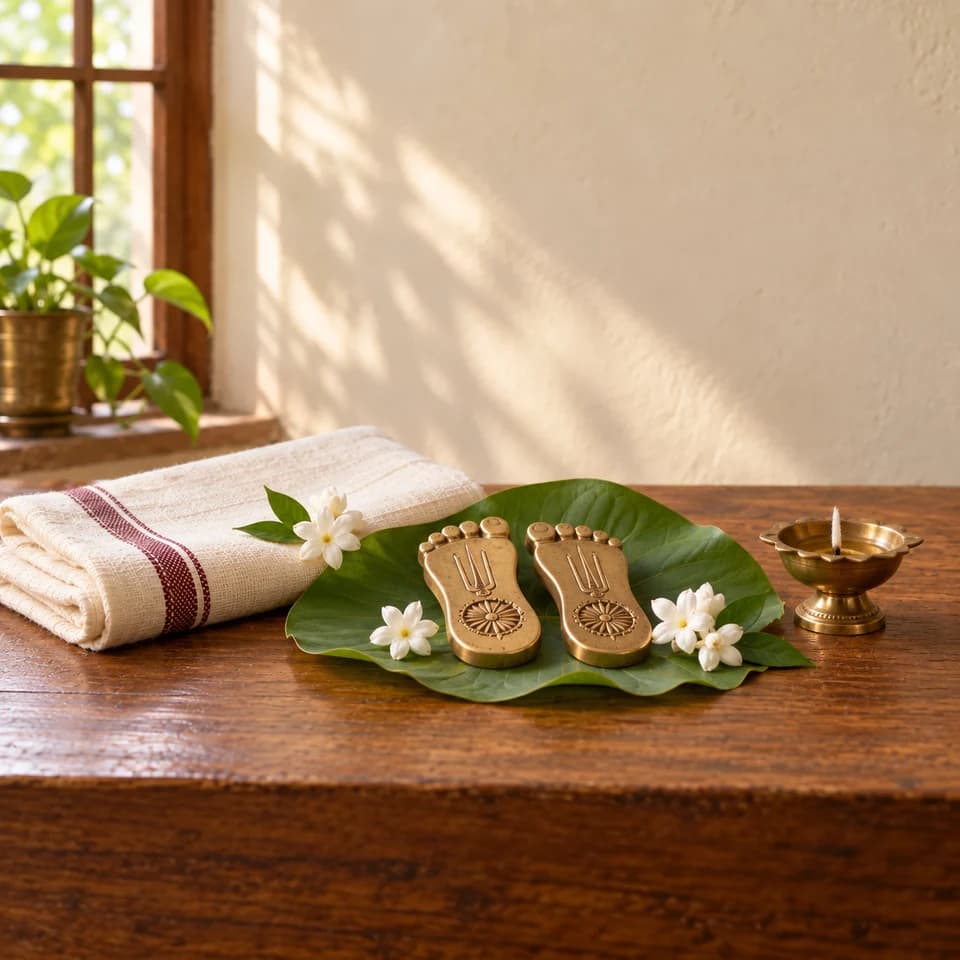
They went on to explain that a seven-hooded form of Sheshnaga was made from darbha grass and worshipped. Vishnu resting on Shesha was remembered, holding a conch, discus, mace and lotus in his four hands. A new thread with fourteen knots was placed in the worship and tied on the right arm afterwards. The old thread was respectfully set aside according to custom.
The women also described giving wheat, ghee, jaggery and fruit, and offering sweets and rice pudding to the deity. Half the prepared food was given to a Brahmin, and the remainder was eaten by those keeping the vow. They explained how the vow was kept for fourteen years and concluded with a ceremony involving the donation of fourteen pots and a meal. Since that very day was Chaturdashi, they invited Sushila to join them.
They gave her a thread with fourteen knots. Sushila worshipped with them and tied the Anant thread. She donated half the wheat bran her father had given her. Then she bowed to everyone and returned to the chariot. By then, Kaundinya had finished his worship too. They got into the chariot and continued their journey.
They came to a city called Amaravati. Its people came out to welcome them. They honoured Kaundinya, accepted him as their ruler and brought the couple into the city with great celebration. The story describes them receiving wealth and happiness through Anant's grace. Sushila and Kaundinya began living there happily.
A few days later, Kaundinya noticed the red thread on Sushila's arm. He asked why she had tied it: had she used some means to bring him under her control? Sushila calmly explained that it was Lord Anant's thread. She said that their prosperity had come through Anant's grace after the day she observed the vow.
Kaundinya grew angry. He believed that everything they had gained was the result of his own great penance. He showed no respect for the Anant thread. He pulled it from Sushila's arm and threw it into the fire. Alarmed, Sushila rushed forward, rescued the thread and placed it in milk.
After this, the couple's life changed. The story links their misfortune to the insult to Anant. The townspeople turned against them. Thieves took their cows, jewellery and possessions. Their home burned down. Their wealth was gone, and they did not even have enough clothes to wear. Kaundinya regretted his conduct. He understood that pride had led him to throw the thread into the fire. He resolved not to take food or water until he saw Anant, and set out into the forest with Sushila to find him.
Calling out to Anant as he walked, he came upon a mango tree covered with blossoms and fruit. Yet no creature or bird approached it. Kaundinya asked the tree whether it had seen Anant. It replied that it had not. It requested him to ask about its condition if he met Anant.
Further on, he found a cow with her calf. Though there was plenty of grass around, she could not eat. Kaundinya asked her where Anant might be. She said she had not seen him, but asked Kaundinya to tell him about her condition if they met.
A little further on, he met a large bull. It too could not take a mouthful of food. Kaundinya asked whether it knew where Anant was. The bull did not know, but asked him to speak on its behalf if he found Anant. Kaundinya continued on his way.
Then he saw two beautiful lakes, filled with lotus and water-lily flowers. The water of each flowed into the other, but even swans and other birds would not drink it. Kaundinya asked them about Anant. The lakes said they did not know him, but requested him to mention their condition if he met him.
Further along, he saw a donkey and an elephant. Kaundinya asked them about Anant too, but they gave no answer. He was exhausted from searching. Unable to find any trace of Anant, he sank into despair. He began to lose the will to live and collapsed on the ground, calling out to Anant.
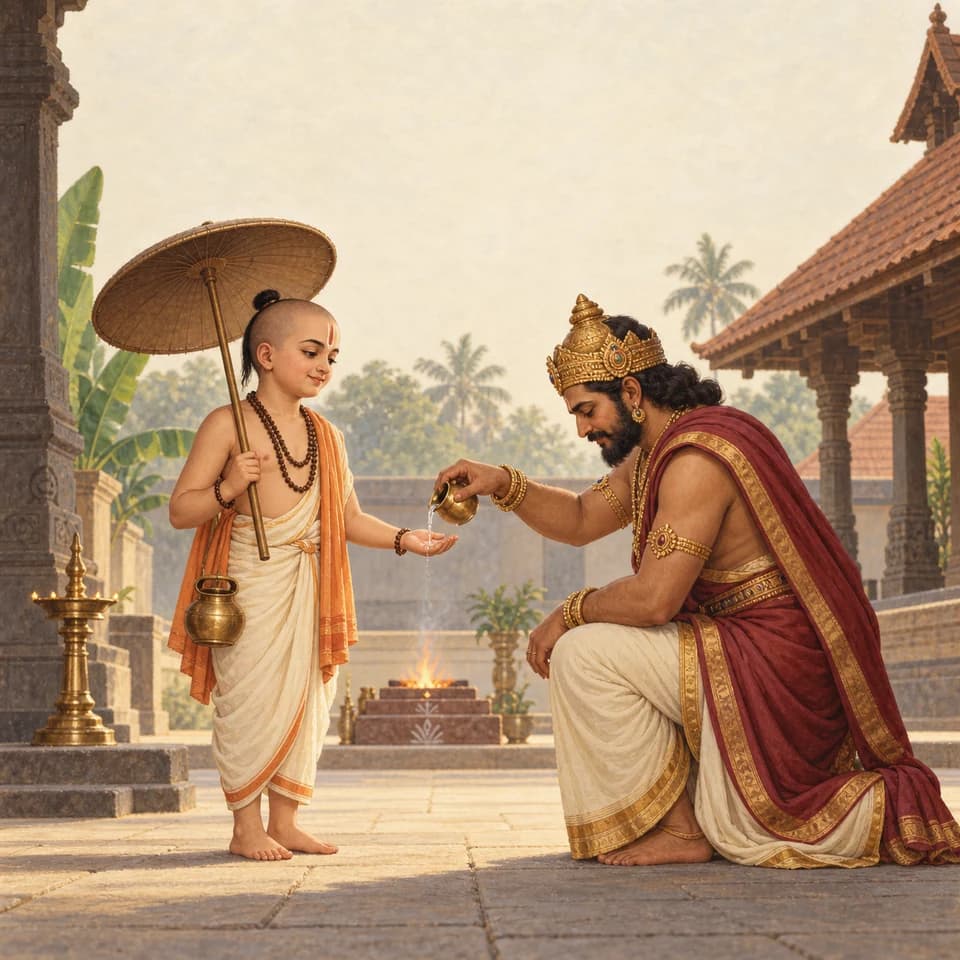
At that moment, an elderly Brahmin came to him. He asked Kaundinya to get up and said that if he was looking for Anant, he would take him to meet him. He held Kaundinya's right hand and helped him stand. They walked together. To Kaundinya's astonishment, a prosperous city like the one before appeared in front of them. The old man took him into the city and seated him on a jewel-studded throne. Then he revealed his divine form. Lord Anant himself had come as the elderly Brahmin.
On seeing the Lord, Kaundinya fell at his feet. He praised him and asked forgiveness for his mistake. He acknowledged him as the world's creator, protector and everyone's refuge. He said that he had not understood devotion and had now come to seek his shelter. Pleased by his prayer, Anant granted three boons: steadfastness in dharma, an end to poverty and, finally, a place in Vaikuntha.
Kaundinya then asked about the sights in the forest. Why did no creature touch the fruit-laden mango tree? Why could the cow and bull not eat despite the grass? Why would birds not drink from the lakes? What did the donkey, elephant and elderly Brahmin mean? Anant explained each in turn. The mango tree had been a Brahmin learned in the Vedas and scriptures in a previous life. Proud of his knowledge, he had refused to teach his pupils, and so had become a tree in this birth.
In her previous life, the cow had donated barren land that produced no crops to a Brahmin. The bull had been a very wealthy Brahmin who never gave charity. The two lakes had been sisters. They exchanged gifts only with each other and gave nothing to anyone else. The story connects their condition with that earlier conduct.
Anant continued: the donkey was Kaundinya's own anger, and the elephant his pride in his penance. When repentance purified his mind, the Lord himself came to him as the elderly Brahmin. He said that all those Kaundinya had met in the forest had now been released from their conditions too. Kaundinya would enjoy happiness and prosperity again. He also blessed him with a place in the Punarvasu constellation at the end.
Kaundinya accepted the Lord's grace. He faithfully observed the Anant vow and regained his kingdom and prosperity. The story says that, after ruling for a long time, he attained heaven. He now embraced with devotion the vow associated with the very thread he had once thrown into the fire in pride.
In this way, Krishna told Yudhishthira the story of Sushila and Kaundinya. The Pandavas followed his advice and observed the Anant vow. The story says that they too regained their lost kingdom.
Why it matters
Sushila accepts the vow with devotion, while Kaundinya credits his prosperity entirely to his own penance. His search and repentance begin after he recognises his mistake. The forest encounters convey the importance of sharing knowledge and wealth, recognising anger and letting go of pride. Families observing Anant's vow associate this story with faith, humility and prayers for peace and well-being.
What people do
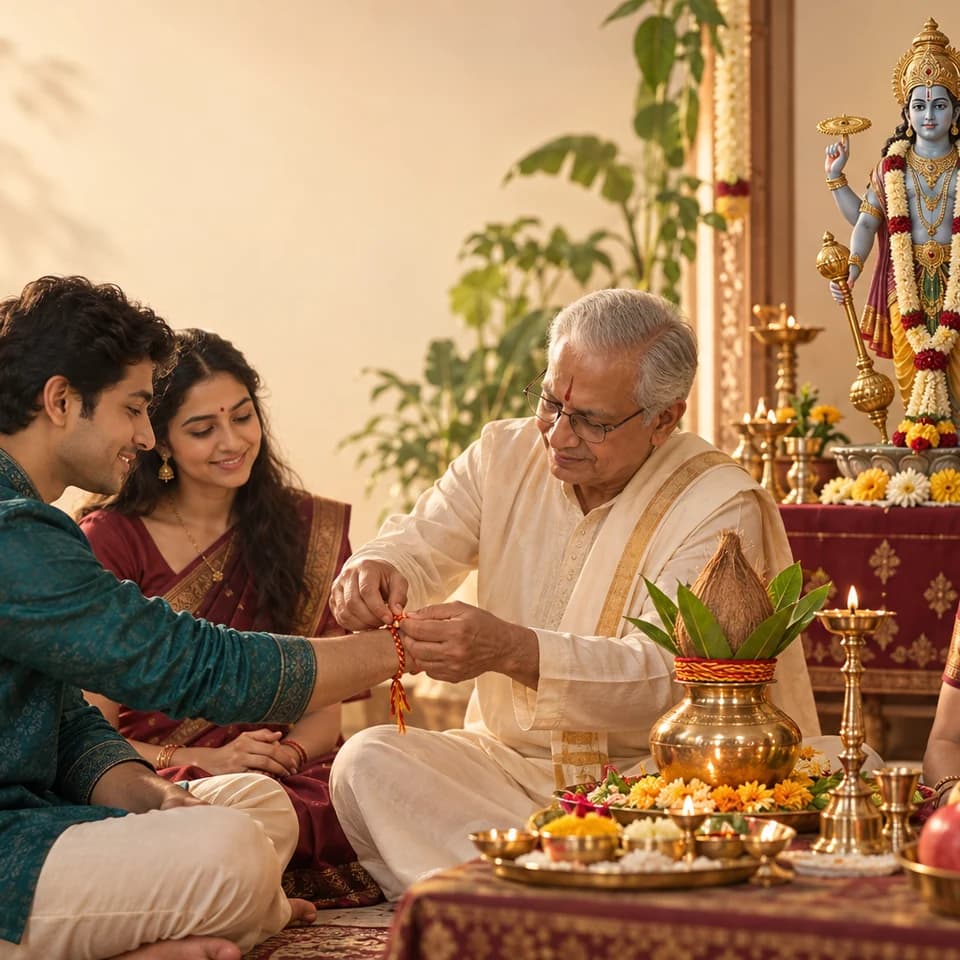
The Anant vow involves worship of Vishnu as Anant. The thread with fourteen knots is placed in the worship and then tied on the arm according to family custom. Some households worship with sacred pots, a Sheshnaga form made of darbha grass, flowers, fruit and sweets. Listening to the story, charity and sharing prasad are also part of the observance.
Some families hold a concluding ceremony after fourteen years of the vow. Fasting and fast-breaking practices vary between temples, traditions and households. Families and community groups immersing Ganesh on this day follow the duration of their own installation and local arrangements.
Told differently elsewhere
Vaishnava temples in places such as Raichur in Karnataka observe Anant worship, storytelling, fasting and prasad. Across regions, family customs differ in the Anant thread, food offerings and the practice of the long-term vow.
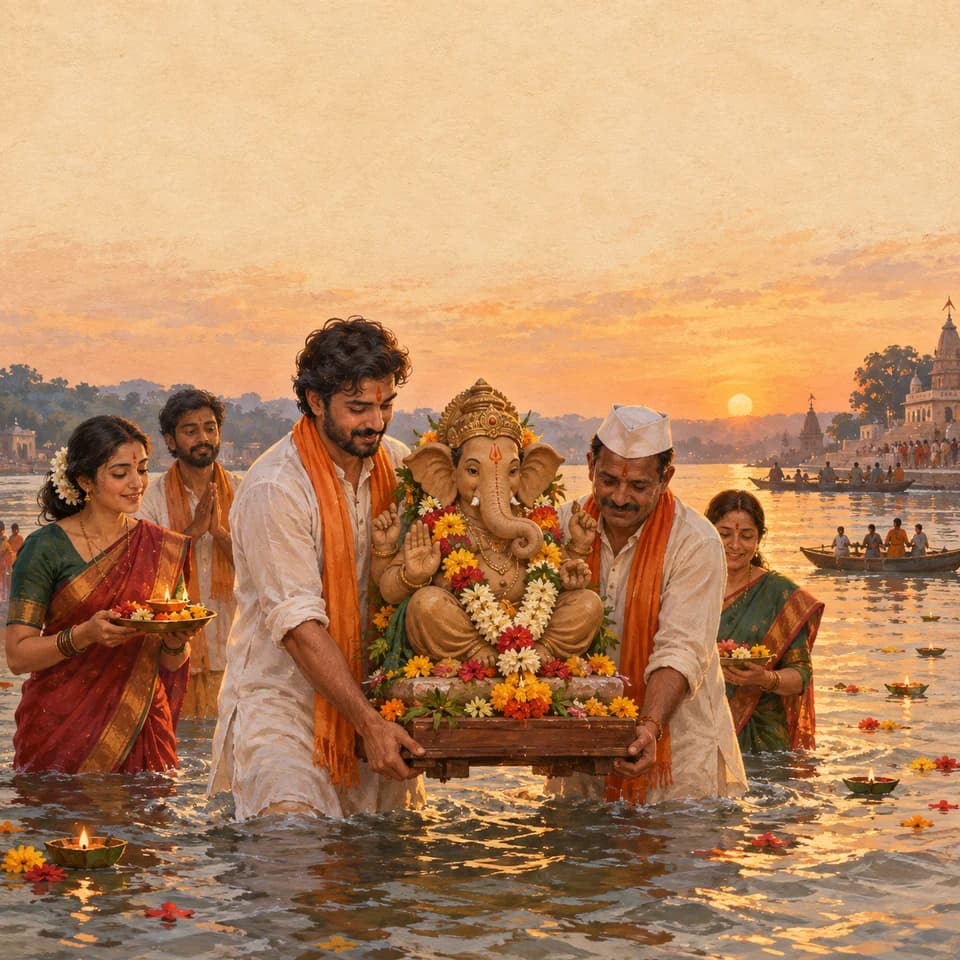
Many Ganesh festival idols in Maharashtra are immersed on Anant Chaturdashi. Indore in Madhya Pradesh also has a tradition of processions with tableaux alongside Ganesh immersion on this day. These practices of welcoming and bidding farewell to Ganesh are separate from Lord Anant's vow story.
In the Digambara Jain tradition, the Dashalakshana festival runs from the fifth to the fourteenth day of the bright half of Bhadrapada. Its concluding observances on Chaturdashi include spiritual practice, fasting and pratikraman. This belongs to its own religious tradition; the date of Kshamavani should also be checked against the relevant Jain calendar and local congregation.
Questions people ask
- When is Anant Chaturdashi in 2061?
- On Wednesday, 28 September 2061 in India. Runs from 27 Sep 18:00 IST to 28 Sep 16:47 IST.
- Why does the date change every year?
- It is kept by the lunar calendar, so its day on the civil calendar moves from year to year.
- Is the date the same everywhere?
- Yes. It is kept everywhere on the day it falls on in India.