Narasimha Jayanti as it falls in 2043.
Next date: 18 May 2027Narasimha Jayanti 2043
Friday, 22 May 2043, in Ahmedabad
Birth anniversaryIndian · Hindu
Panchang on the day
22
Friday
Waxing Fourteenth
until 02:41 next day
Libra
- રRa
- તTa
Puja time
19:17 to 21:41
At dusk, IST
- Sunrise
- 05:55
- Sunset
- 19:17
- Moonrise
- 18:02
- Nakshatra
- Swati
- until 16:05
- Yoga
- Variyana
- until 22:06
- Karana
- Gara
- until 13:26
- Rahu Kalam 10:56 to 12:36
- Yamaganda 15:57 to 17:37
- Abhijit muhurat 12:09 to 13:03
Why this date
Vaishakh Waxing Fourteenth, taken at dusk
Runs from 22 May 00:10 IST to 23 May 02:41 IST.
In short
Narasimha Jayanti is celebrated on Vaishakha Shukla Chaturdashi in remembrance of Vishnu's Narasimha incarnation. The Bhagavata Purana tells of Prahlada's protection and Hiranyakashipu's death. Devotees worship Narasimha, listen to the story, sing bhajans and keep the vrat according to their tradition.
The story
Narada was telling Yudhishthira about Prahlada. When Vishnu killed Hiranyaksha in his Varaha incarnation, his brother Hiranyakashipu became furious and wanted revenge. He sent his asura followers to disrupt sacrifices, spiritual practice, Vedic study and religious life. Villages, hermitages and settlements came under attack. Hiranyakashipu wanted more than a kingdom. He wanted power that no one could overcome.
He went to a valley of Mount Mandara to practise severe austerities. Raising his arms and looking towards the sky, he stood on his toes. The account describes the heat of his practice spreading through the worlds. A long time passed. An anthill covered his body and grass grew over it. Ants ate away his flesh, yet he remained absorbed in his resolve. Troubled by the heat, the gods approached Brahma and asked him to bring the disturbance to an end.
While Hiranyakashipu was away, the gods, led by Indra, attacked the asuras. They fled to save their lives. Indra captured Hiranyakashipu's pregnant wife, Kayadhu. Suspecting that her child would become like its father, he intended to hold her until the birth. As he took her away, Narada met them. He told Indra that she was innocent and that the child in her womb was a great devotee of the Lord. Indra accepted his advice and released her.
Narada took Kayadhu to his ashram and offered her safety until her husband returned. She served him and listened to his teachings about the self and devotion. The story says that Prahlada, still in her womb, also heard this instruction. Through Narada's blessing, it stayed in his heart. Kayadhu wished to give birth after Hiranyakashipu returned, and remained there waiting for him.
Meanwhile, Brahma reached Hiranyakashipu with Bhrigu, Daksha and other sages. Seeing his body covered by the anthill, Brahma praised his determination. He sprinkled water from his vessel, and Hiranyakashipu emerged with a strong, youthful body. Hiranyakashipu bowed and offered prayers. Invited to ask for a boon, he set out many conditions for his protection. No creature created by Brahma should kill him. He should die neither inside nor outside a house, neither by day nor by night, neither on earth nor in the sky, neither by a weapon nor at the hands of a human or animal. He sought safety from gods, asuras, nagas, and anything living or lifeless, and asked that no one defeat him in battle. He also sought authority over all and extraordinary powers. Brahma granted the boon.
His pride grew after receiving these gifts. He defeated the rulers of different worlds and took up residence in Indra's palace. People bowed before him. He even seized the offerings meant for the gods in sacrifices. Power and wealth did nothing to lessen his hatred of Vishnu. The distressed gods and sages turned to the Lord. They were assured that Hiranyakashipu's cruelty would end. When he persecuted his innocent son Prahlada, the time for his downfall would come.
Hiranyakashipu had four sons. Prahlada was very different from his father. He was calm, humble and kind to everyone. He respected his elders and wished others well. From childhood, his heart rested in Vishnu. Sometimes he sang in remembrance, sometimes laughed with joy, and sometimes tears filled his eyes. He felt no pride in his father's power or wealth.
Hiranyakashipu sent Prahlada to study with Shukracharya's two sons, Shanda and Amarka. Other asura children studied there too. The teachers taught politics, wealth and the running of a kingdom. They explained how to identify friends and enemies and act accordingly. Prahlada listened and repeated his lessons, but disliked this division of everyone into one's own people and outsiders.
One day, Hiranyakashipu lovingly seated Prahlada on his lap and asked what he considered the best thing he had learnt. Prahlada said it was better to loosen attachment to the body and household and seek the Lord's shelter than live in anxiety under their hold. Hearing Vishnu's devotion from his son, Hiranyakashipu suspected an enemy had corrupted him. He told the teachers to watch the child more carefully and prevent any Vaishnava from approaching him.
The teachers asked who had taught him these things. Prahlada explained that the division between one's own people and enemies arose through the Lord's maya. Just as iron was drawn to a magnet, his mind was drawn to Vishnu. They threatened him and taught their lessons again. Later, his mother bathed and dressed him and sent him to his father. Once more, Hiranyakashipu took him on his lap and asked what good he had learnt. Prahlada described nine ways of devotion. These were hearing about the Lord, singing his qualities, remembering him, serving his feet, worshipping, bowing, serving as his attendant, loving him as a friend and offering oneself to him.
Hiranyakashipu turned angrily on the teachers. They insisted they had not taught this devotion. Prahlada's mind turned towards it by itself. When his father questioned him again, Prahlada said that people absorbed only in pleasure and attachment could not recognise their true good. The company of the Lord's devotees was needed. Hiranyakashipu now lost control of his anger. He threw the child from his lap to the ground and ordered his servants to kill him. A son devoted to Vishnu, who had killed his brother, seemed an enemy to him. Prahlada was only five years old.
The asura servants struck Prahlada with tridents. He remained peacefully absorbed in the Lord, and their blows had no effect. Hiranyakashipu then tried many other ways to kill him. He put him beneath elephants' feet and among poisonous snakes, gave him poison and denied him food. He tried throwing him from a mountain, crushing him with great stones, and harming him through sorcery and illusion. Cold, wind, fire and water could not hurt him either. Every attempt failed, and Prahlada continued to remember Vishnu.
Unable to harm his son, Hiranyakashipu himself became worried. Why did this child fear none of his punishments? Shanda and Amarka urged patience. They advised binding Prahlada with Varuna's noose until Shukracharya returned, then resuming his education. Hiranyakashipu agreed. Prahlada went back to his teachers, but his devotion remained firm.
When the teachers were occupied with household duties, the children invited Prahlada to play. He lovingly gathered them around and spoke about the Lord. He urged them to use life well from childhood instead of waiting until old age to begin devotion. The body changed, but the self was distinct from those changes. Since the Lord dwelt in every heart, they should wish everyone well. The company of devotees, prayer, remembrance and service could lessen desire, anger, greed and jealousy. His friends asked where he had learnt all this when he had studied alongside them. Prahlada then told them how he had heard Narada's teaching in his mother's womb. The children put aside their toys and listened attentively. Their minds also turned towards devotion to Vishnu.
When Shanda and Amarka saw the change, they became frightened and reported everything to Hiranyakashipu. Trembling with anger, he summoned Prahlada. The child stood quietly with folded hands. Hiranyakashipu demanded to know whose strength allowed him to disregard his orders. Prahlada answered that the same Lord gave strength to both father and son, and to everyone. He asked his father to let go of anger and hostility and regard everyone equally. He should not boast of conquering others without first mastering his own mind.
The answer made Hiranyakashipu angrier. Where was the Lord whom Prahlada said was everywhere? Was he in this pillar in the assembly hall? Threatening to kill the child, he rose from his throne, took his sword and struck the pillar with his fist. A tremendous roar came from within. Its force terrified the asuras. Hiranyakashipu looked around, unable at first to understand where it came from.
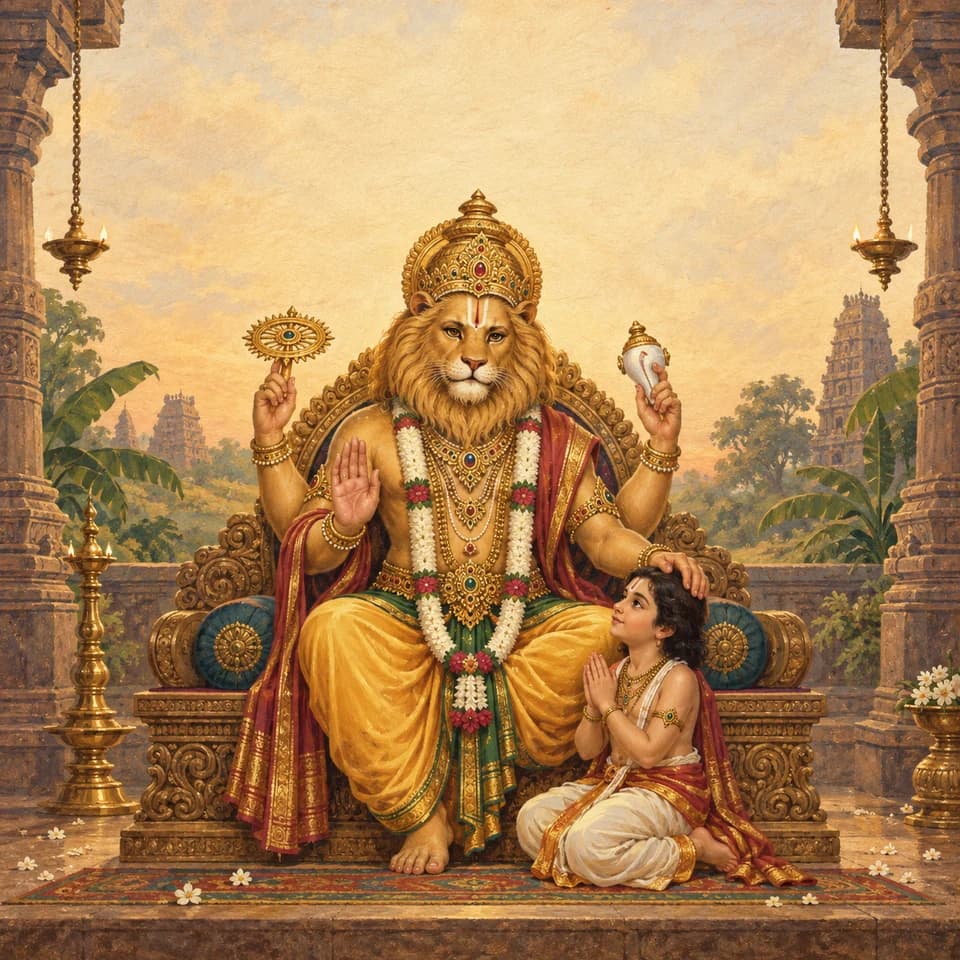
An extraordinary form emerged from the pillar, neither wholly human nor lion. Narasimha stood before him with a lion's face, blazing eyes, a spreading mane, sharp teeth, a broad chest and many arms. Hiranyakashipu thought Vishnu had taken this form to kill him. Still proud of his strength, he rushed at Narasimha with a mace. Narasimha caught him together with his mace, then let him slip free. Hiranyakashipu imagined that Narasimha feared him. After a pause, he attacked again with sword and shield.
Hiranyakashipu moved swiftly up and down to defend himself. With a roar, Narasimha caught him again. It was twilight, neither full day nor night. At the doorway of the hall, neither wholly inside nor outside, he placed Hiranyakashipu on his thighs, neither on the ground nor in the sky. Using his nails instead of a weapon, he tore open Hiranyakashipu's body and killed him. Appearing in this extraordinary form, neither an ordinary human nor animal, he brought his end within the conditions of Brahma's boon.
Hiranyakashipu's soldiers came armed to fight, and Narasimha destroyed them too. His anger had not yet subsided. His roar spread fear as he sat on the assembly's throne. With the tyrant's death, the gods felt relief. Flowers showered from the sky, celestial drums sounded and singing began. Brahma, Shiva, Indra, the sages and other divine groups offered their prayers. Those whose worship, spiritual practice or rightful place Hiranyakashipu had taken away expressed their joy at being free.
Yet no one dared approach the fierce Narasimha. The gods asked Lakshmi to go forward, but she too had never seen this extraordinary form and held back. Brahma then asked Prahlada to approach and calm him. Prahlada went slowly, folded his hands and bowed at his feet. Seeing the child, Narasimha's love for his devotee overflowed. He raised Prahlada and placed his hand on his head. Prahlada's heart filled with love and tears came to his eyes.
Fixing his mind and gaze on the Lord, Prahlada began to pray. He had none of the gods' power or learning, yet could offer a prayer through devotion. Wealth, high birth, beauty, knowledge or austerity alone did not please the Lord. Pure devotion was dear to him. Sincere surrender was greater than pride without devotion. The Lord needed nothing, but worship benefited the devotee. With this understanding, Prahlada found courage to praise him as best he could.
He asked Narasimha to let his anger subside. His father's cruelty had ended and everyone had found relief. Prahlada said he did not fear the Lord's fierce face, teeth, nails or roar. He feared a life trapped in attachment and suffering. He had not forgotten Narada's kindness in showing him the right path. He wanted to serve the Lord and his devotees. He described the world as arising through the Lord's power and remembered the incarnations through which he protected living beings. Since the mind and senses pulled him towards different desires, he asked for shelter.
Prahlada's prayer was not only for himself. He felt compassion for others trapped in suffering and the pursuit of pleasure. He did not want to leave everyone behind and seek liberation alone. He wished to bring others to the Lord's shelter too. He prayed through bowing, praise, work for the Lord, worship, remembrance and listening to his stories. Narasimha was pleased and invited him to ask for a boon.
Prahlada asked for no pleasure or riches. Seeking personal gain in exchange for devotion would be a transaction, he explained. He wished to serve the Lord freely. If a boon must be given, he asked that desires for enjoyment should not arise in his heart. Narasimha accepted his devotion and told him to shoulder the responsibility of kingship until the end of the period of a Manu. He should continue to hear the Lord's stories, keep his mind on him and fulfil his duties. After doing so, he would become free from bondage and attain him.
Prahlada then prayed for his father. In ignorance, Hiranyakashipu had hated the Lord and persecuted his own son. Prahlada asked that these offences be forgiven. Narasimha said his father had been purified, together with twenty-one forefathers of his family. The birth of such a peaceful, devoted son had benefited the lineage. He instructed Prahlada to perform his father's funeral rites and then take responsibility for the kingdom. Prahlada obeyed and carried out the rites.
Brahma also offered prayers and expressed joy that Prahlada had survived. Narasimha told him not to grant boons to cruel people such as Hiranyakashipu that would increase their pride and oppression. Then the Lord disappeared. Prahlada bowed to Brahma, Shiva and the other gods. With Shukracharya and the sages, Brahma installed him as king of the asuras and danavas. The gods blessed him and returned to their own abodes. Keeping his mind on the Lord, Prahlada took up his responsibility as king.
Why it matters
Alongside Prahlada's unwavering devotion, the story expresses compassion for everyone and his plea for forgiveness even for the father who persecuted him. Hiranyakashipu oppresses others through pride in strength and his boon, while Prahlada seeks the Lord's shelter and urges an end to hostility. Devotees pray for protection and remember faith, courage and compassion.
What people do
Narasimha and Vishnu temples hold darshan, abhisheka, aarti, devotional singing and readings of Prahlada's story. Devotees offer flowers, Tulsi and food according to their tradition. Narasimha's appearance is remembered especially in the evening worship. Some temples also hold abhisheka in the morning. Services throughout the day follow the temple's practices.
Fasting
Fasting follows health and tradition. Some Vaishnava communities fast until dusk and take prasad after worship. In another vrat tradition, the fast ends the next day after Chaturdashi has finished. The parana time is checked according to the family or temple's practice and the local panchang.
Told differently elsewhere
Ahobilam in Andhra Pradesh is an important centre of Narasimha worship, with a tradition of worshipping nine forms. ISKCON temples in places such as Bengaluru in Karnataka and Mayapur in West Bengal hold special abhishekas, bhajans and services for Narasimha Chaturdashi.
Vaishnava and Swaminarayan devotees in Gujarat also observe Narasimha Jayanti. Fasting food, offerings and worship differ by religious tradition and family. The festival tithi and evening worship time are checked with the local panchang and temple.
Questions people ask
- When is Narasimha Jayanti in 2043?
- On Friday, 22 May 2043 in India. Runs from 22 May 00:10 IST to 23 May 02:41 IST.
- Why does the date change every year?
- It is kept by the lunar calendar, so its day on the civil calendar moves from year to year.
- Is the date the same everywhere?
- Yes. It is kept everywhere on the day it falls on in Delhi.
Dates in the coming years
- 2027Tuesday, 18 MayVaishakh Sud 14 · Puja 19:15
- 2028Sunday, 7 MayVaishakh Sud 14 · Puja 19:11
- 2029Saturday, 26 MayVaishakh Sud 14 · Puja 19:19
- 2030Thursday, 16 MayVaishakh Sud 14 · Puja 19:15
- 2031Monday, 5 MayVaishakh Sud 14 · Puja 19:09
Last kept30 April 2026