Chhath Puja as it falls in 2035.
Next date: 15 November 2026Chhath Puja 2035
Monday, 5 November 2035, in Ahmedabad
FestivalIndian · Hindu
Panchang on the day
5
Monday
Waxing Fifth
until 16:59
Sagittarius
- ભBha
- ધDha
- ફPha
Puja time
18:00 to 20:24
At dusk, IST
- Sunrise
- 06:45
- Sunset
- 18:00
- Moonrise
- 10:58
- Nakshatra
- Purva Ashadha
- until 09:33 next day
- Yoga
- Sukarma
- until 10:04
- Karana
- Balava
- until 16:59
- Rahu Kalam 08:09 to 09:34
- Yamaganda 10:58 to 12:23
- Abhijit muhurat 12:00 to 12:45
Why this date
Kartik Waxing Sixth, taken at dusk
Runs from 5 Nov 16:59 IST to 6 Nov 19:38 IST.
In short
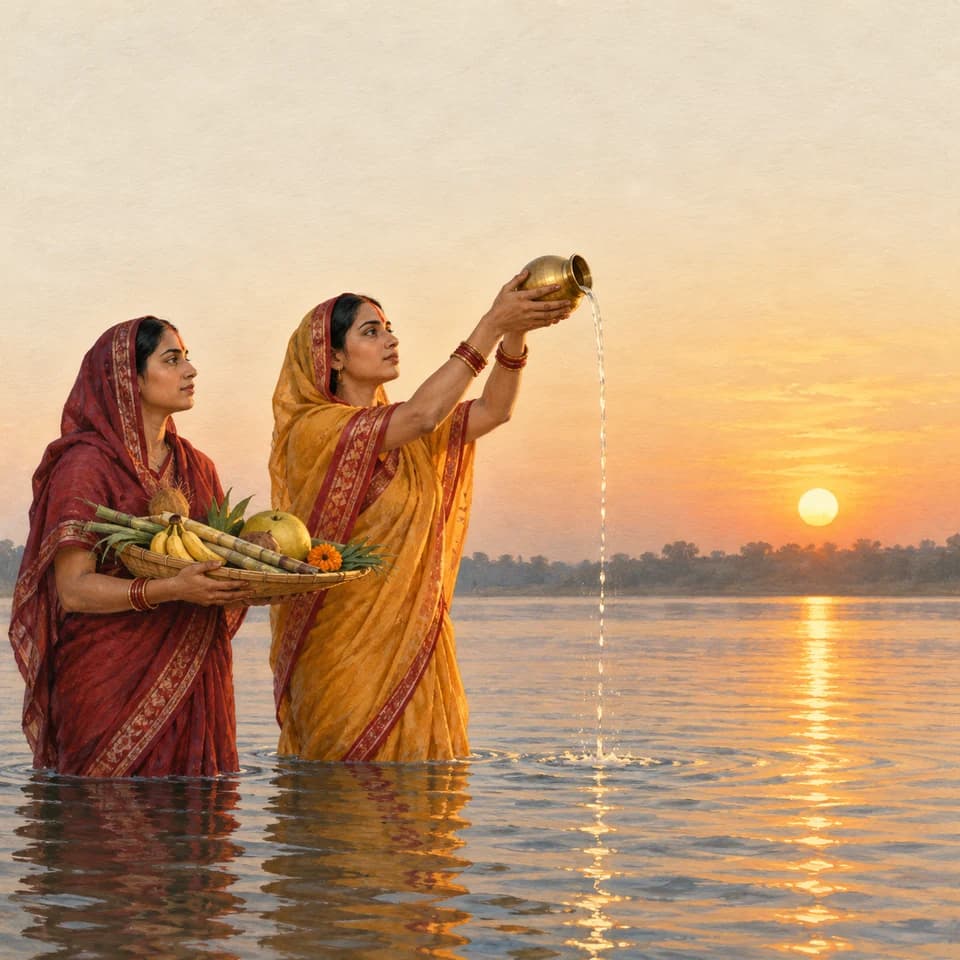
Chhath Puja honours Surya, the Sun god, and Chhathi Maiya. During the four days from Kartik Shukla Chaturthi to Saptami, families pray for health and well-being. They go to the water to offer arghya to the setting and rising Sun. Arghya is a respectful offering of water in worship.
The story
Chhathi Maiya is also worshipped as Shashthi Devi. One Puranic story about Shashthi Devi, who protects children, tells of King Priyavrata and Queen Malini.
Priyavrata had spent his early years practising austerities. He married on Brahma’s advice. Many years passed, but he and Malini had no child. Hoping for a child, they asked the sage Kashyapa to perform a yajna. The sage gave Malini the blessed offering from the rite. After taking it, she became pregnant.
According to the story, twelve years passed in the gods’ reckoning before Malini gave birth to a son. The child was stillborn. The women of the household and the relatives began to weep, and Malini fainted with grief. The king held the child to his chest and went to the cremation ground. Even there, he could not bring himself to let go of his son.
Just then a shining chariot decorated with garlands appeared in the sky. A goddess sat in it. The king laid the child down, bowed to her and asked who she was. She introduced herself as Devasena, the daughter of Brahma and wife of Kartikeya. As the sixth part of Prakriti, she was known as Shashthi. In this story she is the goddess who protects children.
The goddess explained to Priyavrata the joys and sorrows of life and the fruits of one’s actions. She then took the child in her lap. In the story, the boy came back to life and began to smile. When the goddess was about to take him away, the king prayed to her again.
The goddess was pleased. She asked the king to worship her and to spread the practice among his people. She said that the child would be called Suvrata and would grow up to be learned and generous. She handed the child back to the king. He agreed to worship her, and the goddess took her leave.
Priyavrata returned to the palace with his son and told everyone what had happened. There was joy throughout the palace. He worshipped Shashthi Devi and began the practice of worshipping her on the sixth day of the bright half of each month. The story says that people also began to worship her on the sixth and twenty-first days after a birth and when a child was first fed solid food.
Other oral traditions associated with Chhath speak separately of Sita’s worship, Karna’s devotion to the Sun, or the prayers of Draupadi and the Pandavas.
Why it matters
Life depends on the Sun’s light and warmth. At Chhath, people thank Surya and pray to Chhathi Maiya for the well-being of their children and families. The evening offering to the setting Sun and the morning offering to the rising Sun are the festival’s distinctive practice.
What people do
The first day, Kartik Shukla Chaturthi, begins with Nahay Khay. People clean the house and kitchen. Those observing the vow bathe and eat a simple meal.
The second day, Shukla Panchami, is Kharna, also called Lohanda. Those keeping the vow fast during the day. After evening worship they take and share offerings such as kheer and fruit. In some families, a waterless fast then lasts until the morning of Saptami.
On the third day, Kartik Shukla Shashthi, families arrange offerings such as thekua, fruit and sugarcane in bamboo baskets. In the evening they gather at a riverbank or by a pond. Amid Chhath songs, they offer Sandhya Arghya to the setting Sun. Some families hold the Kosi ceremony at night, placing lamps and offerings under a small canopy made of sugarcane stalks.
On the fourth day, early on Saptami, devotees return to the water before sunrise. They offer Usha Arghya to the rising Sun. Afterwards they break the fast with prasad and share it with family and neighbours. People observe the fast with their health in mind and follow local instructions at the ghats.
Told differently elsewhere
Chhath Puja has particular importance in Bihar, Jharkhand, eastern Uttar Pradesh and the Terai of Nepal. In Janakpur, Nepal, devotees offer arghya by the ponds. In Kathmandu, people also gather along the Bagmati River. Families from these regions celebrate together wherever they settle. Some places also observe Chaiti Chhath in the month of Chaitra.
Questions people ask
- When is Chhath Puja in 2035?
- On Monday, 5 November 2035 in India. Runs from 5 Nov 16:59 IST to 6 Nov 19:38 IST.
- Why does the date change every year?
- It is kept by the lunar calendar, so its day on the civil calendar moves from year to year.
- Is the date the same everywhere?
- Yes. It is kept everywhere on the day it falls on in Patna.
Dates in the coming years
- 2026Sunday, 15 NovemberKartik Sud 6 · Puja 17:56in 3 days
- 2027Thursday, 4 NovemberKartik Sud 6 · Puja 18:01
- 2028Monday, 23 OctoberKartik Sud 6 · Puja 18:08
- 2029Sunday, 11 NovemberKartik Sud 6 · Puja 17:57
- 2030Thursday, 31 OctoberKartik Sud 6 · Puja 18:03
Last kept27 October 2025