Gita Jayanti as it falls in 2030.
Next date: 20 December 2026Gita Jayanti 2030
Thursday, 5 December 2030, in Ahmedabad
ObservanceIndian · Hindu
Bhagavad Gita Jayanti
Panchang on the day
5
Thursday
Waxing Eleventh
until 18:44

Pisces
- દDa
- ચCha
- ઝJha
- થTha
- Sunrise
- 07:05
- Sunset
- 17:55
- Moonrise
- 14:42
- Nakshatra
- Revati
- until 16:29
- Yoga
- Vyatipata
- until 12:09
- Karana
- Vishti
- until 18:44
- Rahu Kalam 13:51 to 15:12
- Yamaganda 07:05 to 08:26
- Abhijit muhurat 12:08 to 12:51
Why this date
Margshirsh Waxing Eleventh, taken at sunrise
Runs from 4 Dec 17:18 IST to 5 Dec 18:44 IST.
In short
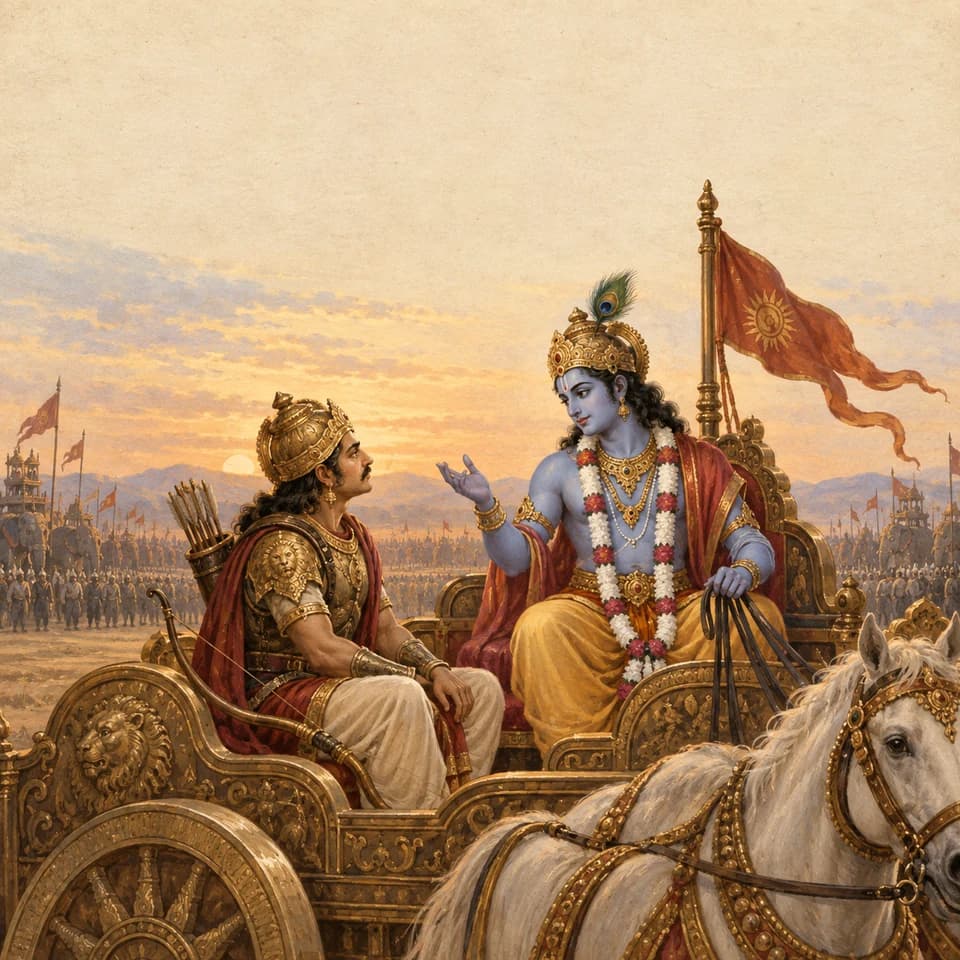
Gita Jayanti is observed on Margashirsha Shukla Ekadashi. In the Mahabharata tradition, Shri Krishna's dialogue with Arjuna at Kurukshetra is known as the Bhagavad Gita. On this day, people remember that conversation, recite the Gita and study its teachings.
The story
On the field of Kurukshetra, the Kaurava and Pandava armies stood facing each other. In Hastinapur, Dhritarashtra asked Sanjaya what his sons and the Pandavas were doing, gathered there for war. Sanjaya began to describe the scene.
Seeing the Pandava army, Duryodhana went to his teacher Drona and spoke of the warriors on both sides. Bhishma sounded his conch. Soon conches and drums rang across the field. Shri Krishna and Arjuna, seated in a chariot drawn by white horses, sounded their conches too.
Arjuna asked his charioteer Krishna to place the chariot between the two armies. He wanted to see who had come to fight. Krishna stopped before Bhishma and Drona. Looking around, Arjuna saw his elders, teachers, brothers, friends and relatives on both sides.
The sight filled Arjuna with sorrow. His limbs grew weak, his mouth dried up and his bow, Gandiva, began to slip from his hand. The very people for whose sake he might want a kingdom and happiness stood before him. He could find no joy in a victory won by killing them. He feared the destruction of families and the loss of their traditions. Putting down his bow and arrows, he sat in the chariot.
Krishna asked him to take courage and rise. Arjuna wondered how he could shoot arrows at revered elders such as Bhishma and Drona. He could not decide whether fighting or withdrawing was right. He told Krishna, 'I am your student. Please explain what is best for me.' Then, saying he would not fight, he fell silent.
Krishna began with the relationship between the soul and the body. The body changes from childhood to youth and old age, but the soul does not perish with it. Just as a person takes off old clothes and puts on new ones, the soul leaves one body and takes another. Pleasure and pain, heat and cold come and go. One should bear them and act with understanding.
He then asked Arjuna to consider his duty. He should focus on the right action, instead of worrying about his own gain or victory and defeat. He could choose to act, but could not fully control the result. Neither clinging to a reward nor choosing complete inaction would resolve his confusion.
Arjuna asked what a person of steady understanding was like. Krishna said such a person did not endlessly chase desires. Happiness did not make them lose their balance, and sorrow did not break them. When the mind kept dwelling on something, desire could grow. Desire could lead to anger, and anger could destroy clear judgement. He therefore explained the importance of caring for the mind and senses.
Arjuna still had a question. If knowledge was better, why was he being asked to undertake something as terrible as war? Krishna explained that no one could remain without action even for a moment. Outwardly giving up work did not remove the mind's desires. Doing one's work without clinging to the result, while considering the welfare of others, was the path of karma yoga. He spoke of kings such as Janaka, who had progressed while fulfilling their responsibilities.
Arjuna asked what drew a person into wrongdoing even against their own wish. Krishna spoke of desire and anger. Desire remained unsatisfied and covered a person's understanding. He asked Arjuna to recognise it and learn to guide his senses, mind and intellect.
Krishna said he had first taught this yoga to the sun god, from whom it had passed to Manu and Ikshvaku. Arjuna was surprised. The sun god belonged to a much earlier time. How could Krishna have taught him? Krishna replied by speaking of his own many births and Arjuna's. He explained that he appeared when dharma declined and wrongdoing grew. True knowledge cleared confusion. To gain that understanding, one should ask questions humbly and learn through serving those who knew.
The conversation returned to giving up work and carrying it out. Krishna explained that a person could work without attachment to its fruits and remain inwardly free. He compared such action to a lotus leaf that remained untouched by the water around it. A person with knowledge saw the soul in all with an equal gaze, whether a scholar or an ordinary person, an animal or a human.
He then described meditation. Sitting in a quiet place, guiding the mind, keeping balance in eating, sleeping and waking, and bringing back a wandering mind were important. Arjuna said the mind was as restless as the wind and hard to control. Krishna acknowledged the difficulty, but said practice and loosening attachment could help. Arjuna also worried about someone whose spiritual effort ended halfway. Krishna assured him that no sincere good effort was lost.
As the dialogue continued, Krishna explained his relationship with the world. The taste of water, the light of the sun and moon, and the strength in living beings were connected with him. He compared the world's dependence on him to beads held together by a thread. Arjuna's questions now reached beyond the battle before him to life, the world and the divine.
Arjuna asked about remembrance at the time of death and the end of life. Krishna asked him to remember him while fulfilling his duty. What a person remembered in the final moment was connected with the habits of a lifetime. He therefore explained how to turn the mind towards the divine again and again.
Speaking of devotion, Krishna said he accepted even a leaf, a flower, a fruit or water offered with love. Whatever a person did, ate, offered or gave could be dedicated to him. He spoke of being equal towards everyone. Even someone who had taken a wrong path could change by turning back with sincere devotion.
Arjuna asked Krishna to say more about his greatness. Krishna invited him to see a glimpse of his presence wherever brilliance, beauty and strength appeared in the world. Arjuna now wanted to see his divine form with his own eyes. Krishna said ordinary sight could not behold it and gave him divine vision.
The universal form appeared before Arjuna. With countless faces, eyes and arms, it spread in every direction. Its radiance was like thousands of suns rising at once. Arjuna saw gods, sages and the whole world together within it. He could see neither its beginning nor its end. Joining his hands, he bowed.
But the vision was also terrifying. Warriors from both sides entered its fiery mouths. Bhishma, Drona, Karna and Dhritarashtra's sons were among them. They rushed into those mouths like rivers flowing into the sea and moths into a flame. Frightened, Arjuna asked who Krishna was in this fierce form.
Krishna described himself as Time, the destroyer of worlds. Whether Arjuna fought or not, the warriors standing before him were already destined to meet their end. He told Arjuna to rise, carry out his work and become an instrument in it.
Arjuna trembled and bowed repeatedly. He remembered how he had treated Krishna as a friend, sometimes calling him by name casually and joking while eating or sitting together. He asked forgiveness for words spoken without knowing his greatness. The extraordinary vision had brought both joy and fear. He begged to see again the familiar form with crown, mace and discus.
Krishna reassured him. Removing Arjuna's fear, he appeared again in his gentle human form. Arjuna regained his composure. Krishna explained the importance of wholehearted devotion in understanding this form.
Arjuna then asked about the path of devotion. Krishna asked him to rest his mind and intellect in him. If that was difficult, he offered ways such as repeated practice, working for Krishna and letting go of attachment to the results. A devotee free from hatred, compassionate, without arrogance and steady in happiness and sorrow was dear to him.
He went on to describe the body as a field, a place where action happened, and spoke of the one who knew that field. Alongside recognising the body, mind and their changes, he explained qualities such as humility, non-violence and self-restraint. He then spoke of sattva, rajas and tamas. These three qualities bound people in different ways. He asked Arjuna to recognise the influences of clarity and peace, desire and restlessness, laziness and ignorance, and move beyond their hold.
To explain the world, he used the image of an upside-down sacred fig tree, with roots above and branches below. People became more entangled in desires and attachment. He explained the path of loosening that hold and seeking the Supreme. He said he dwelt in every heart and that memory and knowledge came from him.
Krishna also distinguished qualities that led towards goodness from those that led towards destruction. Fearlessness, truth, compassion and a disciplined mind stood on one side. Pretence, pride, anger and harshness stood on the other. He called desire, anger and greed three gateways to downfall. He asked Arjuna to turn to scripture to understand what to do and what to avoid.
Arjuna asked about faith. Krishna explained that faith differed according to a person's nature. These differences appeared in food, sacrifice, austerity and giving too. The dialogue also included speaking truthfully without hurting others, keeping the mind calm and giving appropriately without expecting a return.
Finally, Arjuna asked about renunciation and letting go. Krishna explained the difference between giving up actions driven by desire and releasing attachment to their fruits. Good practices such as sacrifice, generosity and self-discipline should continue. Many causes lay behind any action, so a person should not proudly claim to have done everything alone. He described fulfilling one's own responsibility thoughtfully, despite its imperfections, and making one's work an offering to the divine.
Krishna then asked Arjuna to reflect fully on everything he had heard and decide as he wished. He went on to say, 'Keep your mind on me, be devoted to me and take refuge in me.' Promising to free Arjuna from sin, he asked him not to grieve.
Krishna asked whether Arjuna had listened with full attention and whether his confusion had cleared. Arjuna replied, 'Through your grace, my confusion has gone and my understanding has returned. I no longer doubt. I will do as you have said.'
Sanjaya told Dhritarashtra that, through Vyasa's grace, he had heard this extraordinary dialogue. Remembering Krishna and Arjuna's words brought him joy again and again. Recalling the universal form filled him with wonder. He ended by expressing his conviction that where Krishna and the bow-bearing Arjuna stood, there were prosperity, victory and steadfast righteousness.
Why it matters
Gita Jayanti is a day to remember Krishna's conversation with Arjuna. In the account, Arjuna openly shares his difficulty, asks questions, listens and becomes ready to decide with understanding. Studying the Gita's teachings about duty, the self, guiding the mind and devotion is part of the festival.
What people do
Devotees read or recite the Bhagavad Gita. Some gatherings recite all eighteen chapters, while others read selected verses and discuss their meaning. Temples hold Krishna worship, devotional singing and talks. Some people also observe the Mokshada Ekadashi vrat that falls on the same tithi, according to their tradition.
Told differently elsewhere
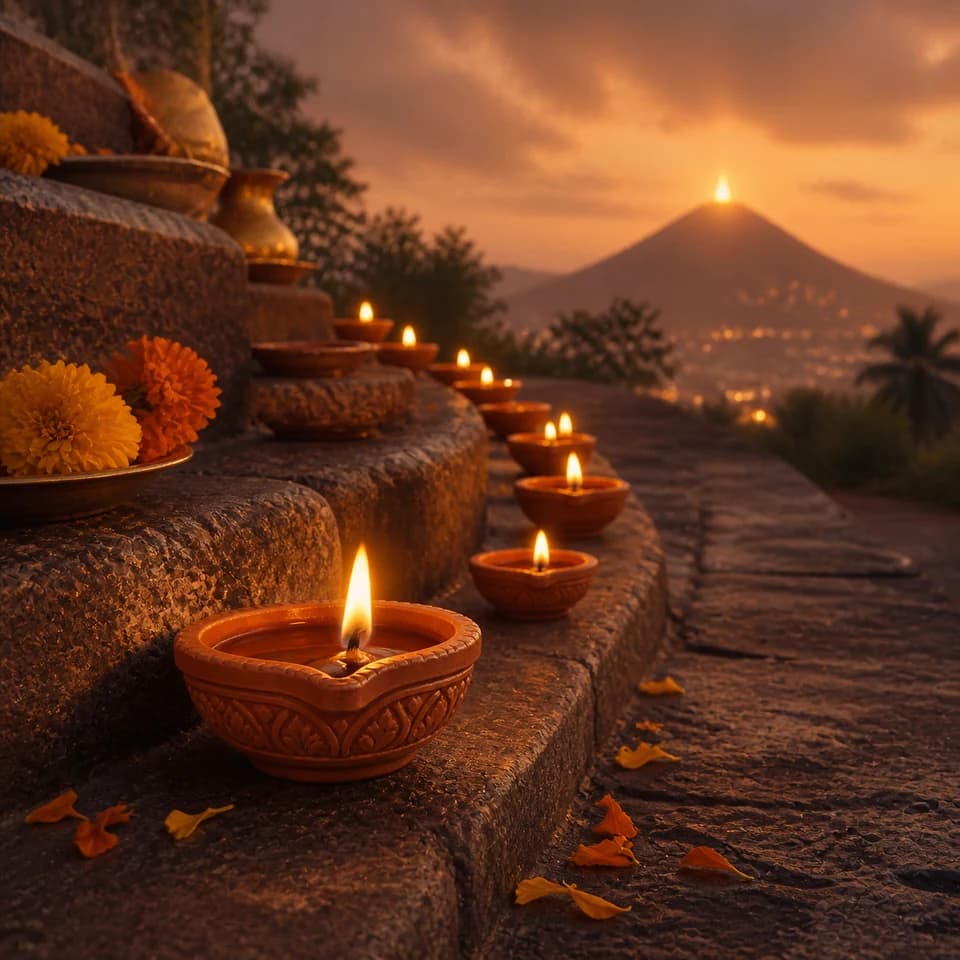
Kurukshetra and Jyotisar in Haryana hold special Gita Jayanti programmes. People join Gita recitations, devotional singing, talks and cultural events. Lamps are also offered near Brahma Sarovar. Temples and religious organisations in other regions arrange recitations and gatherings according to their own traditions.
Questions people ask
- When is Gita Jayanti in 2030?
- On Thursday, 5 December 2030 in India. Runs from 4 Dec 17:18 IST to 5 Dec 18:44 IST.
- Why does the date change every year?
- It is kept by the lunar calendar, so its day on the civil calendar moves from year to year.
- Is the date the same everywhere?
- Usually. Where sunrise falls at a different moment the day can differ by one, and the dates here are worked out for India.