Rath Yatra as it falls in 2031.
Next date: 5 July 2027Rath Yatra 2031
Sunday, 22 June 2031, in Ahmedabad
FestivalGujarati · Hindu
Panchang on the day
22
Sunday
Waxing Second
until 08:51
Gemini
- કKa
- છChha
- ઘGha
- Sunrise
- 05:53
- Sunset
- 19:29
- Moonrise
- 07:50
- Nakshatra
- Punarvasu
- until 15:04
- Yoga
- Dhruva
- until 15:22
- Karana
- Kaulava
- until 08:51
- Rahu Kalam 17:47 to 19:29
- Yamaganda 12:41 to 14:23
- Abhijit muhurat 12:14 to 13:08
Why this date
Ashadh Waxing Second, taken at sunrise
Runs from 21 Jun 06:22 IST to 22 Jun 08:51 IST.
In short
On the second day of the bright half of Ashadha, Jagannath, Balabhadra and Subhadra ride in chariots pulled by devotees. In Puri, Odisha, the chariots travel from the Jagannath Temple to the Gundicha Temple. Ahmedabad also holds its Rath Yatra on Ashadhi Bij. Puri’s procession is associated with this story of King Indradyumna.
The story
King Indradyumna ruled in Avanti, in the land of Malwa. He was devoted to Vishnu. One day during worship, he asked his priest whether there was a place where he could see the Lord with his own eyes. The priest put the question to the pilgrims sitting there. One pilgrim who had visited many sacred places told the king about Purushottama Kshetra by the sea. There, on Mount Nila, Lord Nila Madhava dwelt deep in the forest.
The king wanted to go there himself. To find the place first, the priest sent his younger brother Vidyapati. When Vidyapati reached the coast, he met Vishvavasu of the Shabara community, a devotee of Nila Madhava. Vishvavasu took him by the hand and led him through the forest. The path was narrow, with stones underfoot and thorns all around. Vishvavasu showed him where to step, and the two reached Rohini Kunda.
A large banyan grew near the pool. Between the two, in the shade of the tree, Vishvavasu showed Vidyapati where Nila Madhava dwelt. Vidyapati bathed in the pool and bowed to the Lord. As the sun went down, Vishvavasu took him home and gave him a meal. Vidyapati was surprised that someone living deep in the forest had such food. Vishvavasu explained that the gods came there to worship and that the food was what had been offered to the Lord.
Vidyapati returned to Avanti carrying a garland that had been offered to the Lord. The king had been waiting eagerly for him. He bowed to the garland and heard Vidyapati’s account. Now he was determined to see Nila Madhava himself. The sage Narada and Vidyapati went with him towards Mount Nila.
Near the mountain the king heard distressing news. Soon after Vidyapati’s visit, the form of Nila Madhava had been covered by sand. Indradyumna was deeply upset and wondered how he would now see the Lord he had come so far to meet. Narada explained that the Lord would appear there again in another form. He brought Brahma’s message that the king should stay and perform yajnas. Once they were complete, he would see the Lord in a wooden form.
The king followed Narada’s advice. He first installed an image of Narasimha and then began the Ashvamedha rites. The story says that he performed a thousand of them. As the final rite was nearing its end, Vishnu appeared to the king in a dream one night. In the morning he told Narada what he had seen. Narada urged him to be patient. The king now felt sure that the Lord would appear again.
At the end of the final rite, the king’s men saw an unusual tree floating in the sea. Its top was in the water and its roots showed above the waves. It bore the marks of a conch and a discus. The king told Narada, who said that the Lord for whom he had been waiting had arrived in this form. They went to the shore together. The tree reminded the king of the form he had seen in his dream. To the sound of conches and instruments, it was brought ashore and placed on the altar.
The king asked Narada who would make the images from this wood. Just then a voice came from the sky. An elderly carpenter had arrived with his tools. The voice told them to let him work inside, close the doors and allow no one to look in for fifteen days. The carpenter told the king that he would make the forms seen in the dream from this wood. In the story, it was Narayana himself who had come as the carpenter.
The king kept the doors closed as instructed, and instruments played outside while the work went on. On the fifteenth day the work was complete. Inside were four forms: Jagannath, Balabhadra, Subhadra and the Sudarshana discus. Instructions were also given for painting and dressing them. The king’s eyes filled with tears of joy when he saw them. Narada told him that the wish for which he had left home was now fulfilled.
Indradyumna began building a temple for the Lord. He called stoneworkers and builders, then went with Narada to Brahma. He asked Brahma to come and install the forms in the temple. Brahma agreed and told him to return to earth first and make the preparations. According to the story, a long time had passed on earth while the king was in Brahma’s realm.
When the king returned, Narada arranged for chariots to carry the images. Padmanidhi gathered the materials, and Vishvakarma built three chariots. Narada blessed them all. The forms of Jagannath, Balabhadra and Subhadra were seated on the chariots. When Brahma arrived, he bowed at each one. Conches and instruments sounded as the images were carefully brought down. Brahma performed their ceremonial bathing and worship and installed Jagannath, Balabhadra, Subhadra and Sudarshana in the temple.
After the installation, Brahma asked the Lord to bless Indradyumna. In the story, the Lord spoke from the wooden image. He told the king that his devotion had pleased him and that he would remain at this place. He asked to be bathed on the full moon of Jyeshtha. Then, on the second day of the bright half of Ashadha, the king was to take him with Balabhadra and Subhadra in chariots to the Gundicha pavilion.
The Lord explained why he wanted to go to Gundicha. The king had performed his yajnas there, and it was there that the Lord had appeared in wooden form. That made the place dear to him. He would stay for a few days so devotees could see him and would then return to his temple. Indradyumna celebrated the festivals as the Lord had asked, with Narada and Padmanidhi helping him. Puri’s Rath Yatra still marks both the journey to Gundicha and the return to the temple.
Why it matters
During Rath Yatra the Lord comes out of the temple, and people standing along the road can see him. Pulling the chariots and helping with the procession are ways to express devotion. In Puri the king himself sweeps the chariots, a reminder that all are equal before the Lord.
What people do
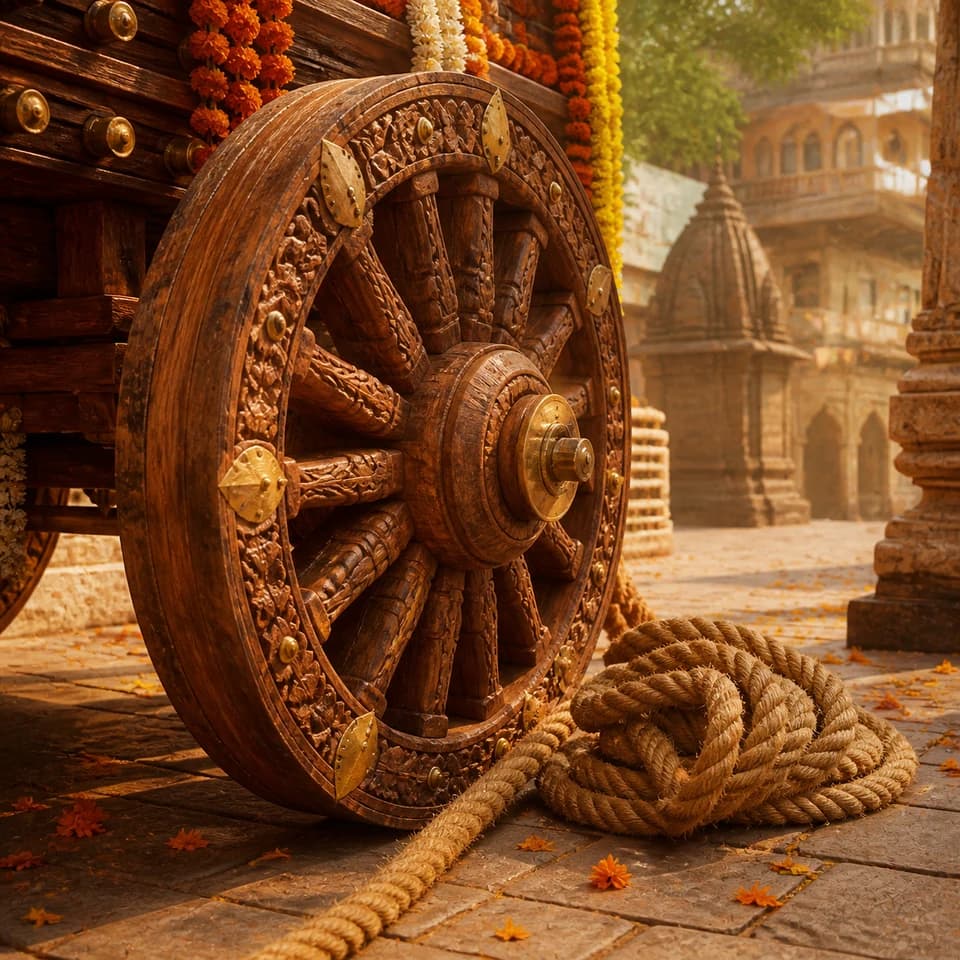
In Puri, the bathing ceremony of Snana Purnima is held on the full moon of Jyeshtha. The temple tradition allows the deities a period of rest afterwards. On Rath Yatra, temple attendants carry the images to the chariots in the Pahandi ceremony. Jagannath’s chariot is called Nandighosha, Balabhadra’s Taladhwaja and Subhadra’s Darpadalana. Puri’s Gajapati king sweeps the chariots with a golden broom in the Chhera Pahanra ceremony. Devotees then pull the chariots by ropes to the Gundicha Temple.
While the deities are at Gundicha, Hera Panchami recalls Lakshmi going there to see Jagannath. A few days later the chariots head back to the main temple on Bahuda Yatra. In Suna Besha the deities are dressed in gold ornaments, and in Adhara Pana they are offered a sweet drink on the chariots. They re-enter the temple on Niladri Bije. In a devotional tradition of Puri, Jagannath offers Lakshmi rasagola to win her over upon his return.
Told differently elsewhere
In Puri, craftspeople prepare three chariots for the procession each year. In Ahmedabad, the chariots set out from the Jagannath Temple in Jamalpur on Ashadhi Bij. After the Pahind ceremony the procession makes its way through the city. In Saraspur, local people serve meals to visiting devotees. The chariots return to the temple in the evening. Each city has its own route and customs.
Questions people ask
- When is Rath Yatra in 2031?
- On Sunday, 22 June 2031 in India. Runs from 21 Jun 06:22 IST to 22 Jun 08:51 IST.
- Why does the date change every year?
- It is kept by the lunar calendar, so its day on the civil calendar moves from year to year.
- Is the date the same everywhere?
- Yes. It is kept everywhere on the day it falls on in Puri.
Dates in the coming years
- 2027Monday, 5 JulyAshadh Sud 2
- 2028Saturday, 24 JuneAshadh Sud 2
- 2029Friday, 13 JulyAshadh Sud 2
- 2030Tuesday, 2 JulyAshadh Sud 2
- 2031Sunday, 22 JuneAshadh Sud 2
Last kept16 July 2026