Tulsi Vivah as it falls in 2030.
Next date: 21 November 2026Tulsi Vivah 2030
Wednesday, 6 November 2030, in Ahmedabad
FestivalGujarati · Hindu
Panchang on the day
6
Wednesday
Waxing Twelfth
until 04:22 next day
Pisces
- દDa
- ચCha
- ઝJha
- થTha
- Sunrise
- 06:46
- Sunset
- 18:00
- Moonrise
- 15:27
- Nakshatra
- Purva Bhadrapada
- until 07:38
- Yoga
- Vyaghata
- until 08:39
- Karana
- Bava
- until 15:59
- Rahu Kalam 12:23 to 13:47
- Yamaganda 08:10 to 09:34
Why this date
Kartik Waxing Eleventh, taken at sunrise, kept the day after
Runs from 5 Nov 03:34 IST to 6 Nov 03:43 IST.
In short
In Kartik, people dress the tulsi plant as a bride and hold a wedding ceremony with a Shaligram or an image of Krishna. Shaligram is a sacred stone worshipped as a form of Vishnu. One story in the Skanda Purana tells of Vrinda and Jalandhara and explains why tulsi is dear to Vishnu.
The story
Once Indra went with the gods to visit Shiva on Mount Kailasa. He saw a stranger and asked where Shiva was. When he got no answer, even after asking several times, he grew angry and struck the stranger with his thunderbolt. The stranger was Shiva himself. The thunderbolt burned to ash and a flame came from Shiva’s third eye. Brihaspati, the gods’ teacher, had Indra bow down and asked Shiva to calm himself. To spare Indra, Shiva cast the flame into the sea.
A child appeared from the flame where the Sindhu River meets the sea. Brahma heard the child crying and came to see what had happened. The lord of the ocean placed the child, whom he called his son, in Brahma’s lap. The child tugged at Brahma’s beard and brought tears to his eyes. The story says this was how he got the name Jalandhara. Brahma said he would grow to be skilled with weapons and that only Shiva could defeat him.
Brahma asked Shukracharya to make Jalandhara king. The lord of the ocean asked Kalanemi for his daughter Vrinda’s hand for Jalandhara. The two were married. Jalandhara began ruling with Shukracharya’s advice. Daityas who had lost to the gods in earlier battles also came to join him.
One day Jalandhara saw Rahu and asked Shukracharya why his head was separated from his body. Shukracharya told him about the churning of the ocean. The gods had taken the treasures that came out of it, and the Daityas had lost. Jalandhara was furious. He sent an envoy named Ghasmara to Indra to demand the return of the treasures taken from his father, the ocean. Indra explained his side but did not return the treasures. Jalandhara marched against the gods with an army of Daityas.
During the battle Shukracharya used his knowledge to bring fallen Daityas back to life. Brihaspati restored the gods with herbs from Mount Drona. When Jalandhara found out, he lifted the mountain and threw it into the sea. Brihaspati went looking for the herbs, but the mountain was gone. He told the gods to retreat. Jalandhara captured Indra’s city of Amaravati, and the gods took refuge in caves on Mount Meru.
The gods called on Vishnu for help. Lakshmi reminded him that Jalandhara was her brother. The story calls them both children of the ocean. Vishnu said that Jalandhara had been born from Shiva’s radiance and had received a boon from Brahma. As Lakshmi’s brother too, he would be spared by Vishnu. Vishnu rode into battle on Garuda. He and Jalandhara fought for a long time. Impressed by Jalandhara’s prowess, Vishnu told him to ask for a boon. Jalandhara asked him to live in his home with Lakshmi, and Vishnu agreed. Jalandhara gave the gods’ posts to his Daityas and began ruling the three worlds. The story says he cared for his subjects as he would for his own children.
One day Narada visited Jalandhara. He spoke of seeing Shiva and Parvati at Kailasa and praised Parvati. Hearing this, Jalandhara wanted to bring her to his own home. He sent Rahu to Kailasa with a message. As Rahu delivered it, a fearsome figure appeared from between Shiva’s brows and seized him. Rahu asked Shiva to protect him. Shiva told the figure to let him go, since Rahu was only carrying a message. Rahu returned and told Jalandhara what had happened.
Jalandhara was angry and set out for Kailasa with his army. The gods asked Shiva to protect them. Shiva took a share of their radiance, added his own and made the Sudarshana discus. Nandi, Ganesha and Kartikeya led Shiva’s forces into battle. Arrows rained from both sides. Virabhadra came to fight, but Jalandhara struck him down with his mace. Then Shiva entered the battlefield himself.
Jalandhara’s arrows and mace could not stand against Shiva. He used his powers to conjure singing and dancing on the battlefield, drawing Shiva’s attention away. He left Shumbha and Nishumbha to carry on the fight, took Shiva’s appearance and went to Parvati. She realised he was not Shiva. She went away and thought of Vishnu. Jalandhara returned to the battlefield. Parvati told Vishnu about the deception. Vishnu said that Vrinda’s devotion to her husband was protecting Jalandhara. He then went to Jalandhara’s city.
Meanwhile, Vrinda had a frightening dream. Jalandhara was riding a buffalo to the south, and their city was swallowed by the sea in darkness. She woke up unsettled. She went to a garden with two friends and then reached the forest. Two fearsome demons came after her. She asked an ascetic sitting there to protect her. At a shout from him the demons turned back.
Vrinda asked the ascetic how her husband was faring in his battle with Shiva. He made a sign and two monkeys rose into the sky. When they came back, it looked to Vrinda as though they had brought Jalandhara’s lifeless body. She fainted. The ascetic sprinkled water on her. When she came to, she wept and begged him to bring Jalandhara back to life. The ascetic said it was hard to bring someone back after Shiva had killed him, but he would try for her sake.
The ascetic vanished from sight, and Jalandhara seemed to be standing alive before Vrinda. Believing her husband had returned, she stayed with him in the forest. Both the ascetic and the man who looked like Jalandhara were Vishnu. He concealed his identity and was intimate with her as though he were her husband. One day she saw him in his own form and understood how he had deceived her.
Angry, Vrinda told Vishnu that he had taken a false form and betrayed her trust. She cursed his two gatekeepers who had come to frighten her to be born as demons and abduct his wife. Vishnu would be separated from his wife and wander in the forest, with the king of the serpents who had appeared as the ascetic’s disciple beside him. Vishnu tried to stop Vrinda, but she entered the fire and died. Vishnu remained there and covered himself with her ashes. The gods tried to comfort him, but he could find no peace.
The battle was still going on. Jalandhara created a false image of Parvati and made it appear that she had been bound to a chariot. Shiva stopped in distress when he saw her. Jalandhara shot arrows at him. Vishnu told Shiva that this was Jalandhara’s illusion. Shiva resumed the fight. When Jalandhara struck Nandi with his mace, Shiva released the Sudarshana discus. Jalandhara died. The story says that Jalandhara’s radiance merged with Shiva and Vrinda’s with Parvati.
The gods were free of the threat from Jalandhara, but Vishnu still grieved for Vrinda. On Shiva’s advice, the gods prayed to the divine power of the Goddess. They were told to go to Gauri, Lakshmi and Svara. The three goddesses gave them seeds and told them to sow them where Vishnu was sitting. They did so. Amla, malati jasmine and tulsi grew from the seeds. In this account, tulsi came from the seed given by Gauri.
The three plants appeared before Vishnu in the forms of women. In the story, tulsi and amla showed him affection. Seeing their affection, he found peace of mind. He returned to Vaikuntha with those forms of tulsi and amla. In remembrance of this story, Vishnu is worshipped beside a tulsi plant at the end of the Kartik vow.
Why it matters
Tulsi has a special place in the worship of Vishnu. In Tulsi Vivah, devotees express that bond through a wedding ceremony. In many traditions the festival is associated with the close of Chaturmas and the return of the wedding season.
What people do
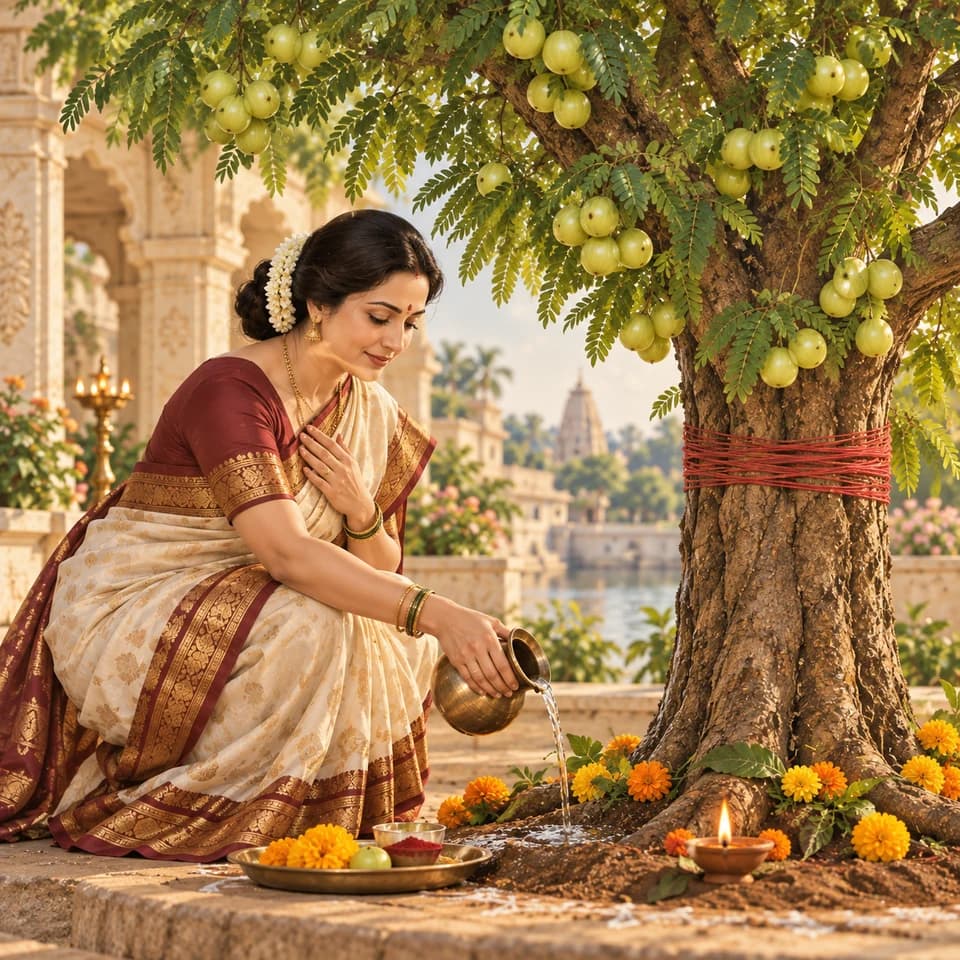
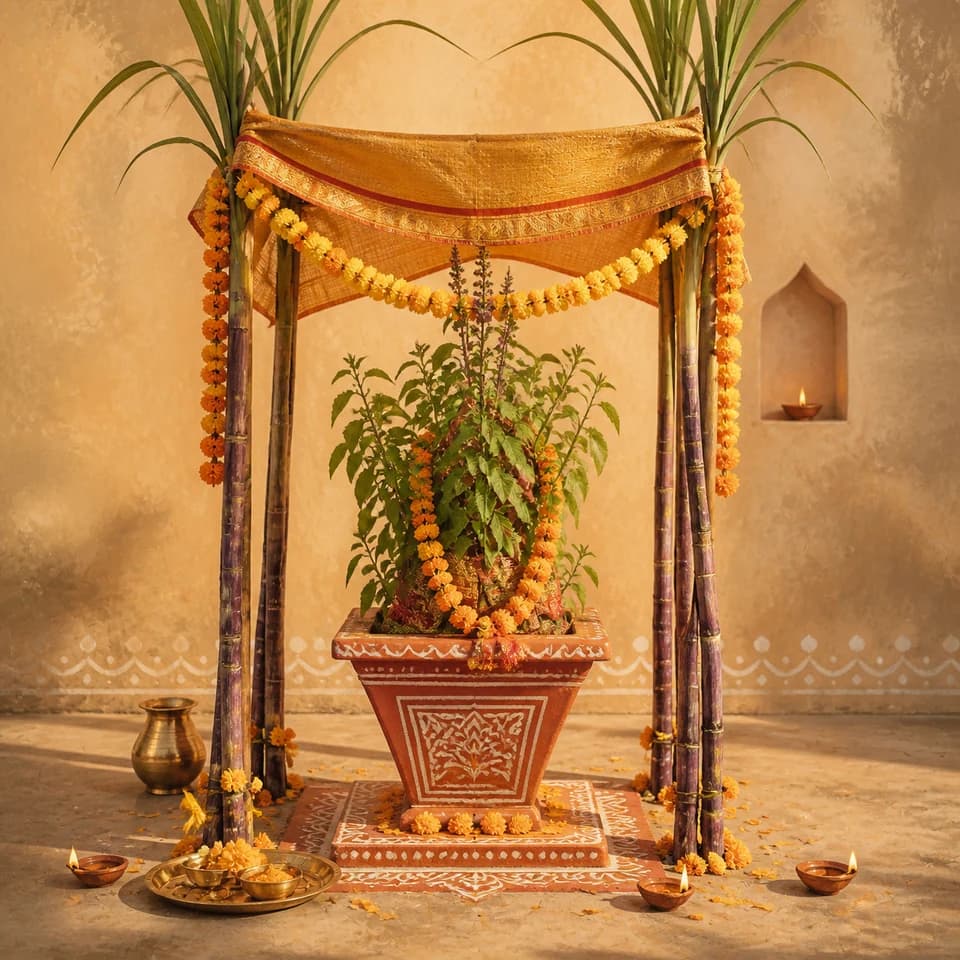
Many families decorate the tulsi in their courtyard with a veil, garlands and bangles. They make a small wedding canopy beside it and place a Shaligram or an image of Krishna there as Vishnu’s form. Families sing wedding songs, perform aarti and share prasad according to their own customs. Some also offer sugarcane.
Told differently elsewhere
Families and temples may observe Tulsi Vivah on Kartik Shukla Ekadashi, Dwadashi or Purnima. In the BAPS tradition, the celebration begins at Prabodhini Ekadashi and ends on the full moon. The Satsangijivan prescribes Kartik Shukla Dwadashi. In Maharashtra, the ceremony is held between Ekadashi and Purnima, with Dwadashi especially common. ISKCON’s Kurukshetra temple holds the Shaligram wedding on Kartik Purnima. Check the local calendar or the temple’s own tradition for the date and time.
Questions people ask
- When is Tulsi Vivah in 2030?
- On Wednesday, 6 November 2030 in India. Runs from 5 Nov 03:34 IST to 6 Nov 03:43 IST.
- Why does the date change every year?
- It is kept by the lunar calendar, so its day on the civil calendar moves from year to year.
- Is the date the same everywhere?
- Yes. It is kept everywhere on the day it falls on in India.
Dates in the coming years
- 2026Saturday, 21 NovemberKartik Sud 12in 10 days
- 2027Thursday, 11 NovemberKartik Sud 12
- 2028Sunday, 29 OctoberKartik Sud 12
- 2029Saturday, 17 NovemberKartik Sud 12
- 2030Wednesday, 6 NovemberKartik Sud 12
Last kept3 November 2025