Varaha Jayanti as it was kept in 1992.
Next date: 3 September 2027Varaha Jayanti 1992
Sunday, 30 August 1992, in Ahmedabad
Birth anniversaryGujarati · Hindu
Panchang on the day
30
Sunday
Waxing Third
until 21:35
Virgo
- પPa
- ઠTha
- ણNa
- Sunrise
- 06:20
- Sunset
- 19:00
- Moonrise
- 08:29
- Nakshatra
- Hasta
- until 03:28 next day
- Yoga
- Shubha
- until 02:25 next day
- Karana
- Taitila
- until 11:07
- Rahu Kalam 17:25 to 19:00
- Yamaganda 12:40 to 14:15
- Abhijit muhurat 12:14 to 13:05
Why this date
Bhadrapad Waxing Third, taken at sunrise
Runs from 30 Aug 00:46 IST to 30 Aug 21:35 IST.
In short
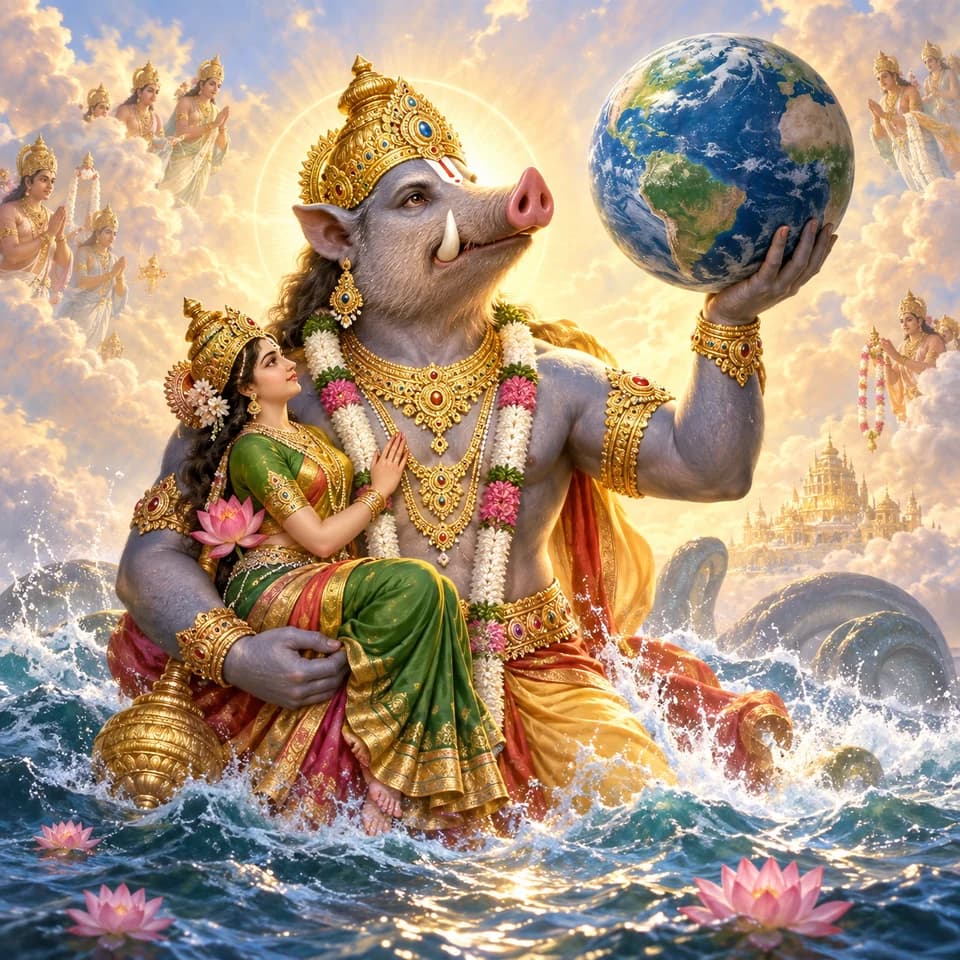
Varaha Jayanti, observed on the third day of the bright half of Bhadrapada, honours Vishnu's Varaha avatar. Varaha is the form of a wild boar. This entry follows the Bhagavata account of Hiranyaksha's defeat, in which Varaha rescues the earth, places it safely and then fights Hiranyaksha.
The story
A demon named Hiranyaksha roamed about in search of someone to fight, proud of his strength. He was the son of Kashyapa and Diti, and the brother of Hiranyakashipu. Carrying a great mace on his shoulder, he approached Varuna, the lord of the waters, and challenged him to battle. Varuna restrained his anger and said that he had retired from warfare.
Varuna told him to approach Vishnu. He could see no one other than the Lord who could face such a skilled fighter. He warned Hiranyaksha that his pride would be broken and he would meet his end in battle when he reached the Lord. Hiranyaksha ignored the warning. After learning the Lord's whereabouts from Narada, he hurried to Rasatala.
There he saw Varaha carrying the earth on his tusks. He laughed at him and called him a forest animal. He claimed that the earth had been entrusted to the inhabitants of Rasatala and that he would not let it be taken away before his eyes. He insulted the Lord as someone fighting for his enemies. He threatened to kill him with his mace and destroy the support of the gods and sages.
The Lord endured his bitter words. The earth on his tusks was frightened, so he continued the task of bringing her safely out first. Hiranyaksha followed, taunting him as a fleeing opponent. Varaha placed the earth on the surface of the water, within his sight, and gave her the support of his own power. Hiranyaksha watched. Brahma praised the Lord, and the gods showered flowers.
After placing the earth safely, the Lord turned to Hiranyaksha. Answering his proud words, he said that he was indeed a forest creature looking for an aggressor like him. He had no fear of the boasting of a demon bound by death. He challenged him to prove his words in battle rather than make empty threats. Hiranyaksha became even angrier.
The demon struck at the Lord's chest with his mace. The Lord moved slightly aside and avoided it. He countered with his own mace towards Hiranyaksha's right brow, but the demon was a skilled fighter and blocked it with his mace. A fierce mace battle followed. Blows landed, wounds opened and blood flowed. Both tried different moves to win.
Brahma came with other sages to watch the battle. He asked the Lord not to give the demon any more freedom. Proud of his boon, Hiranyaksha had been tormenting the gods, Brahmins, cows and innocent beings. The dangerous evening period was approaching, when his powers of illusion might grow stronger. The favourable moment called Abhijit was also passing. Brahma prayed that the Lord would end him quickly and restore peace to the worlds.
Varaha accepted Brahma's prayer with a smile and an affectionate glance. He leapt forward and swung his mace towards Hiranyaksha's chin. A blow from the demon's mace knocked the Lord's mace out of his hand, and it fell spinning to the ground. The watching gods and sages cried out in alarm. Hiranyaksha had a chance to strike, but followed the warrior's rule of not attacking an unarmed opponent. The Lord appreciated this restraint and called upon the Sudarshana discus.
The Sudarshana discus began spinning in the Lord's hand. Hiranyaksha rushed forward in anger and hurled his mace again. The Lord easily knocked it down with his left foot. He told the demon to pick up his weapon and try again. Hiranyaksha swung it once more, but this time the Lord stood in place and caught it. Ashamed that his strength had been defeated so easily, the demon would not even take back the mace the Lord offered.
Hiranyaksha now raised a trident that blazed like fire and hurled it with all his strength. It shone brightly in the sky, but the Lord shattered it with the Sudarshana discus. Roaring in anger, the demon came close, punched the Lord's chest and vanished. Varaha did not move at all; it was as if an elephant had been struck by a garland of flowers.
Hiranyaksha then spread terrible illusions. Fierce winds blew from every direction, and dust darkened the air. Stones began to rain down. Clouds covered the light of the sky, with lightning and thunder. Blood, pus, hair, bones and waste appeared to fall from above. Those watching felt as though the world's destruction had begun.
Mountains appeared to rain down weapons. Naked demonesses with loose hair came forward carrying tridents. Yakshas and Rakshasas on foot, horses, chariots and elephants shouted violently. All of this was the demon's illusion. The Lord used the Sudarshana discus, and the terrifying visions disappeared.
At that very moment, Hiranyaksha's mother Diti trembled in her heart. She remembered her husband Kashyapa's warning: her sons would torment living beings, and the Lord would appear to end them. Blood flowed from her breasts.
Seeing his illusions destroyed, Hiranyaksha approached the Lord again. He tried to catch him between his arms and crush him. To his astonishment, the Lord stood outside his grasp. He attacked again with hard punches. Varaha then struck him once at the root of the ear.
The blow sent Hiranyaksha's body reeling. His eyes bulged, his limbs went limp and his hair scattered. Like a great tree uprooted by a fierce wind, he fell to the ground and died. The strength that had frightened everyone had come to an end.
Brahma and the other gods looked upon his body. The radiance of his face had not yet faded. Brahma said that the demon had left his body while looking at the face of the Lord whom yogis meditate upon in solitude. Such an end was rare. He also recalled that Hiranyaksha and his brother had originally served the Lord. A curse had caused their birth in a demonic family; after a few births they would return to their former place.
The gods bowed repeatedly to Varaha. They praised him for taking this form to protect the world. They expressed their relief at the end of the demon who had troubled the worlds. The earth had been rescued, and Hiranyaksha, who had opposed her protection, had been defeated.
As Brahma and the gods continued praising him, Varaha returned to his own abode, where joyful celebration never ends. Maitreya told Vidura that he had related this account of the avatar as he had heard it from his teacher. Vidura was filled with joy on hearing it.
Why it matters
The earth appears in this story as the home of all living beings. Varaha brings her out and places her safely before facing the battle. Devotees associate this with the Lord's protection and care for life. Giving priority to the earth's rescue despite Hiranyaksha's pride and threats is an important theme of the account.
What people do
Devotees worship Varaha and Vishnu. They read or listen to the story of the earth's rescue and offer praises. Varaha temples hold special worship and ceremonial bathing according to their own traditions. Worship timings and offerings follow the particular temple's programme.
Told differently elsewhere
At Tirumala in Andhra Pradesh, the Sri Bhuvaraha Swami temple stands beside Swami Pushkarini. Tirumala is also known as Adi Varaha Kshetra. Varaha Jayanti is observed there with special ceremonial bathing and the temple's traditional celebrations.
For the Jayanti associated with the third day of the bright half of Bhadrapada, consult the local calendar and temple programme. The choice of observance day and worship timings is not identical everywhere. A temple's special festival or another Varaha observance should be understood according to that temple's tradition.
Questions people ask
- When is Varaha Jayanti in 1992?
- On Sunday, 30 August 1992 in India. Runs from 30 Aug 00:46 IST to 30 Aug 21:35 IST.
- Why does the date change every year?
- It is kept by the lunar calendar, so its day on the civil calendar moves from year to year.
- Is the date the same everywhere?
- Yes. It is kept everywhere on the day it falls on in India.
Dates in the coming years
- 2027Friday, 3 SeptemberBhadrapad Sud 3
- 2028Tuesday, 22 AugustBhadrapad Sud 3
- 2029Monday, 10 SeptemberBhadrapad Sud 3
- 2030Saturday, 31 AugustBhadrapad Sud 3
- 2031Friday, 19 SeptemberBhadrapad Sud 3
Last kept14 September 2026